What is a GEO template?
A GEO template is a contract for every retrievable passage in an article: what each passage must open with, what it must contain, and how many concrete figures it needs. A normal template decides what kind of article to write. A GEO template decides what each passage must contain to be cited.
100 free credits · no card · your first article in about four minutes.
- Opens with
- The complete definition, in the form "{kw} is a … that …". Present tense. No pronoun. Must contain the exact phrase "{kw}".
- Contains
- One clean definition sentence, then two or three sentences of scope and boundaries.
Why does the passage matter more than the page?
AI answer engines do not read your article whole. They split it into short passages, embed each one, and quote the single passage that best matches a sub-query — with none of the surrounding page attached. So “include a comparison table” is not a GEO instruction. “The table must be preceded by one sentence naming what is being compared, so it still makes sense when lifted out” is.
A normal template produces
It also supports scheduled publishing, which many teams find useful once volume increases past a handful of posts a month.
Lifted out of the page, this answers nothing. “It” has no referent.
A GEO template produces
ActiveGeo schedules publishing on a weekly, daily or draft-only cadence, per project. A schedule fills each calendar slot with a full drafted article rather than a title.
Self-contained. Names the subject, states the mechanism, survives extraction.
What does a passage contract look like?
Here are the first three passages of the Definitive Answer template, exactly as the engine receives them.
Opens with — The complete definition, in the form "{kw} is a … that …". Present tense. No pronoun. Must contain the exact phrase "{kw}".
Contains — One clean definition sentence, then two or three sentences of scope and boundaries.
Opens with — A sentence naming {kw} again, then the mechanism.
Contains — The mechanism step by step. Every piece of jargon is defined where it first appears.
Opens with — The consequence, stated directly as a fact rather than as a question.
Contains — The practical impact, with at least one cited statistic linked inline to its source.
The “opens with” line is the load-bearing one. A passage that begins “It also supports…” is uninterpretable the moment an engine lifts it out — which is exactly what an engine does.
Which GEO templates are there?
Ten, each targeting a class of question AI engines actually fan a prompt out into. The table below compares every one of them: what it wins, the query pattern it is built for, and the passage contract it enforces.
| Template | Wins | Query pattern | Contract |
|---|---|---|---|
| Definitive Answer | Wins "what is X" queries with one extractable 40–55 word passage. | 7 passages · ≥10 figures · ≥4 sources | |
| X vs Y Comparison | One article, four fan-out slots: verdict, table, pricing, alternatives. | 8 passages · ≥12 figures · ≥4 sources | |
| Best-of & Alternatives | Every pick becomes its own retrievable passage. Listicles are the top-cited structure. | 6 passages · ≥14 figures · ≥5 sources | |
| How-to & Procedure | Each step is a self-contained passage, so every step competes on its own. | 6 passages · ≥8 figures · ≥3 sources | |
| Question Cluster | 12–18 independent Q&A passages. The highest fan-out surface area per article. | 2 passages · ≥12 figures · ≥5 sources | |
| Statistics Roundup | Pure data density. The format other writers quote — which compounds into mentions. | 5 passages · ≥25 figures · ≥8 sources | |
| Troubleshooting & Fixes | Symptom → cause → fix triples. The most under-served high-intent query class. | 6 passages · ≥4 figures · ≥3 sources | |
| Pricing & Cost Breakdown | Answers with a number, not "it depends". Cost queries are won by whoever commits. | 7 passages · ≥15 figures · ≥4 sources | |
| Data Study | Original research — the only durable GEO moat. Requires your own data. | 7 passages · ≥20 figures · ≥2 sources | |
| Entity Profile | The page that tells engines which brand you are. Every brand needs exactly one. | 8 passages · ≥10 figures · ≥4 sources |
Plus 13 classic templates that inherit the universal GEO layer, and any number of your own — described in a sentence and drafted by AI, or built row by row.
Can I clone one and make it mine?
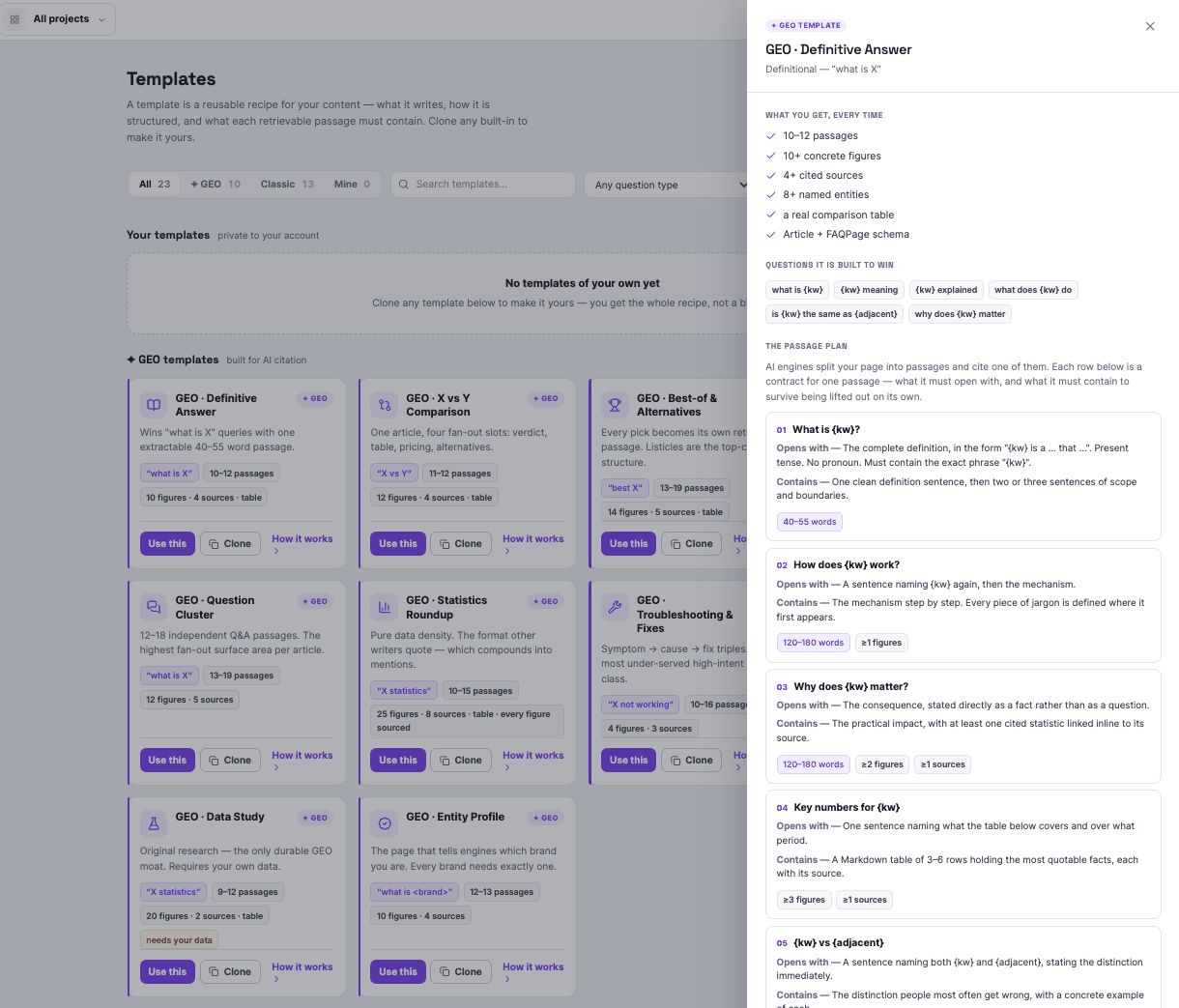
Every template is a starting point, not a cage. Clone any built-in and edit its passage plan row by row: change what a passage opens with, raise the evidence floor, add a slot. Or describe the article you want in a sentence and have AI draft the plan for you, then edit what it produced.
- Custom templates in your own brand voice
- Per project, so an agency keeps clients separate
- LinkedIn and newsletter formats disable GEO mode honestly, rather than showing a badge that means nothing
What does it cost to use one?
Nothing to start. Every template is on the free plan — all ten GEO ones, the 13 classic ones, the full editor and the GEO score. You do not need a card to find out whether this works on your own site.
Yearly plans are billed once for twelve months, shown here per month. Cancel renewal any time.
Free
Try it on your own site
- ModelDeepSeek
- GEO score — all 16 checks, each showing its rule
- Answer-first passage writing, built to be quoted
- Every content template, and the full editor
- Critic pass — a second look before you read it
- Images chosen and inserted for you, free and licensed
- Internal links and an FAQ block, added automatically
- Connect WordPress and publish for real
- One weekly schedule — watch it run itself
- Free AI-visibility check, unlimited, no signup
Pro
Set it running
- Models4 providers, 5 models
- Live research and source citations as you write
- GEO auto-optimise, and the chunk view that shows what an engine lifts
- Unlimited schedules — daily, weekly, drafts or live
- AI-crawler report: which bots fetch you, which pages they never touch
- Search Console AI impressions beside your own crawler data
- Custom templates in your brand voice
- Multiple projects and publish destinations
- Priority support
BYOK
Bring your own API key
- ModelsAny model, your key
- No credit ceiling — volume is between you and your provider
- No markup on a single token
- Unlimited schedules on every model
- Live research and citations
- Custom templates in your brand voice
- Multiple projects and publish destinations
Do the classic templates still work?
Yes, and they got better. All 13 classic templates inherit the universal GEO layer when GEO mode is on — answer-first openings, self-contained sections, evidence floors, question-form headings — plus a short format-specific note of their own. Someone who never picks a GEO template still gets GEO-shaped output.
Two templates opt out honestly: LinkedIn threads and newsletters. Answer engines do not retrieve social posts or email, so GEO mode is disabled for them rather than shown as a badge that means nothing.
Frequently asked questions
What is a GEO template?
A GEO template is a contract for every retrievable passage in an article: what each passage must open with, what it must contain, and how many concrete figures it needs. A normal template decides what kind of article to write; a GEO template decides what each passage must contain to survive being lifted out of the page and cited.
Why does the passage matter more than the page?
AI answer engines split a retrieved page into short passages, embed each one separately, and quote the single passage that best answers a sub-query. A 2,000-word article is roughly 25 competing passages, and the surrounding page is not attached when one is quoted.
Do I have to use a GEO template?
No. Every template — including the 13 classic ones and any you create — inherits the universal GEO layer when GEO mode is on: answer-first openings, self-contained sections, evidence floors and question-form headings. A GEO template adds a specific per-passage contract on top.
Can I build my own?
Yes. Custom templates can define their own passage plan row by row, or start from a built-in GEO template and edit it. You can also describe what you want and have AI draft the plan for you.
Do GEO templates work for LinkedIn posts or newsletters?
No, and we do not pretend otherwise. Answer engines do not retrieve social posts or email, so GEO mode is automatically disabled for those formats rather than shown as a badge that means nothing.
Write one article on a GEO template and read the score.
Then check whether the engines can reach it. Both are free, and the second one needs no account at all.
Last updated 9 September 2026 · Read what the evidence actually says about GEO