
Everything in the
workspace.
This is ActiveGeo’s AI content optimization tool: written to be quoted, scored so you can argue with the number, illustrated only when you ask, and published without losing the structured data on the way out. Here is the whole product, including the parts that are deliberately switched off.
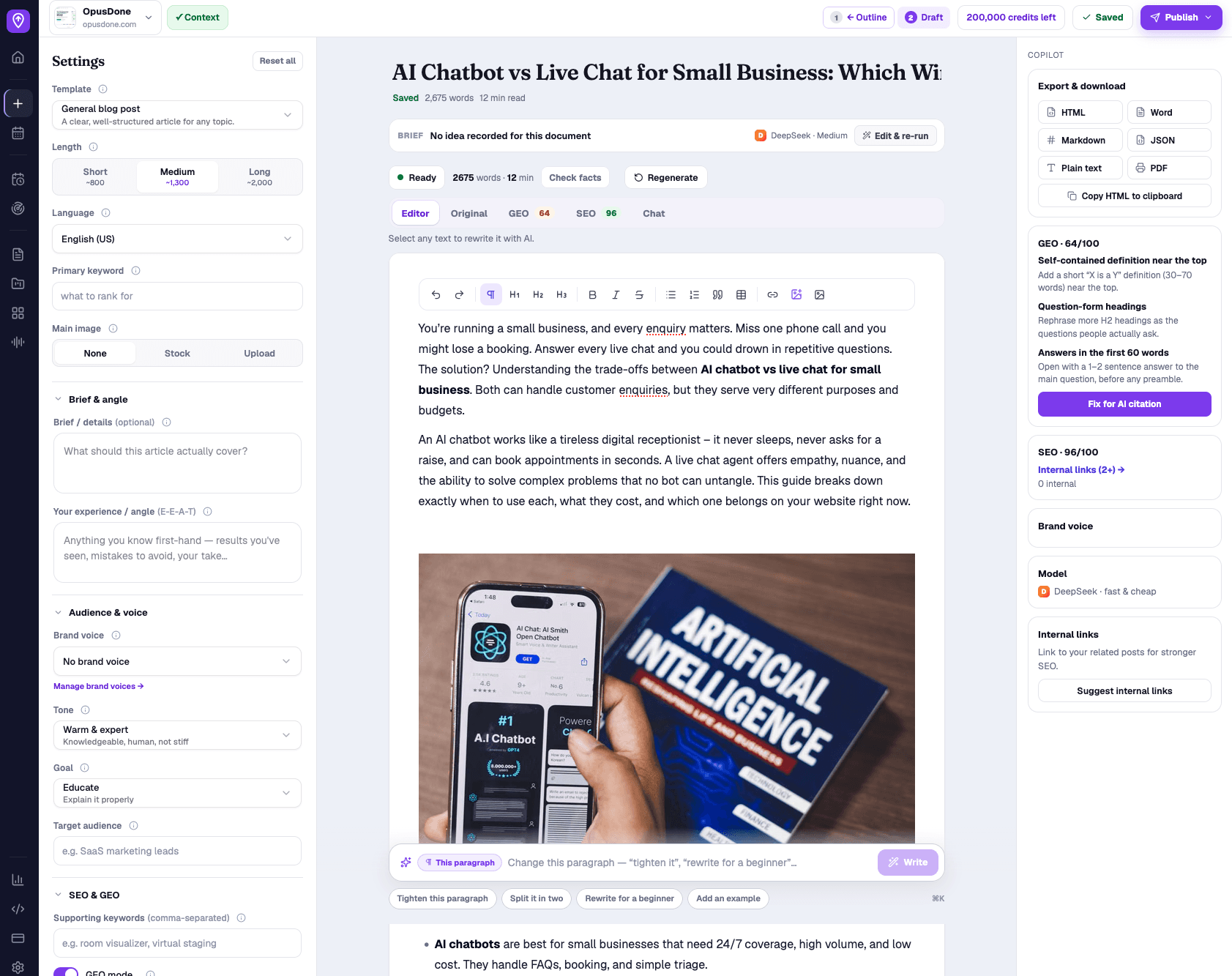
A studio, not a text box.
One guided flow from a sentence to a finished article, and you can stop, edit or reverse it at every step.
Idea → angles → outline → draft.
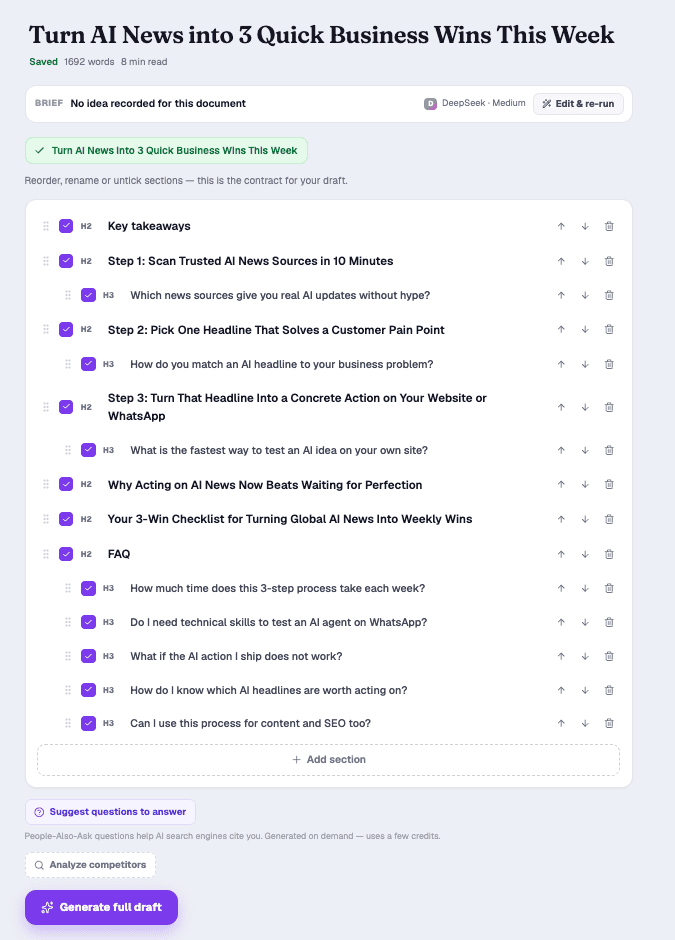
Type a sentence. Get back several distinct angles, then an editable H2/H3 outline you reorder, rename and prune. Accept it and the article types itself into the editor, section by section, with the first words landing in under a second.
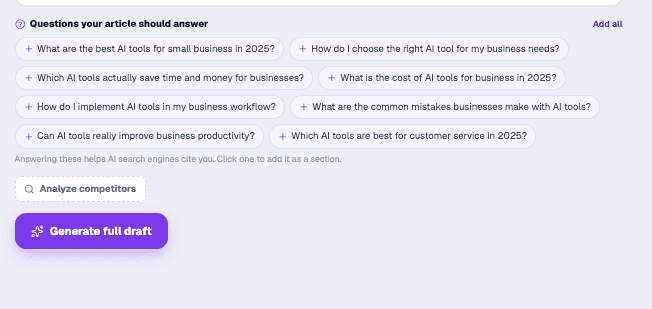
The outline is the contract, the draft follows it exactly, which is why shaping structure here costs nothing and fixing it afterwards is a rewrite. An FAQ block is built in, and two buttons underneath do the work most people skip: Suggest questions to answer pulls the real People-Also-Ask questions for your topic. Click one and it becomes a section, and Analyze competitors reads what already ranks.
- Short ~800 · Medium ~1,300 · Long ~2,000
- 5 models, switchable per article
- People-Also-Ask questions, one click
- Analyze competitors · FAQ block built in
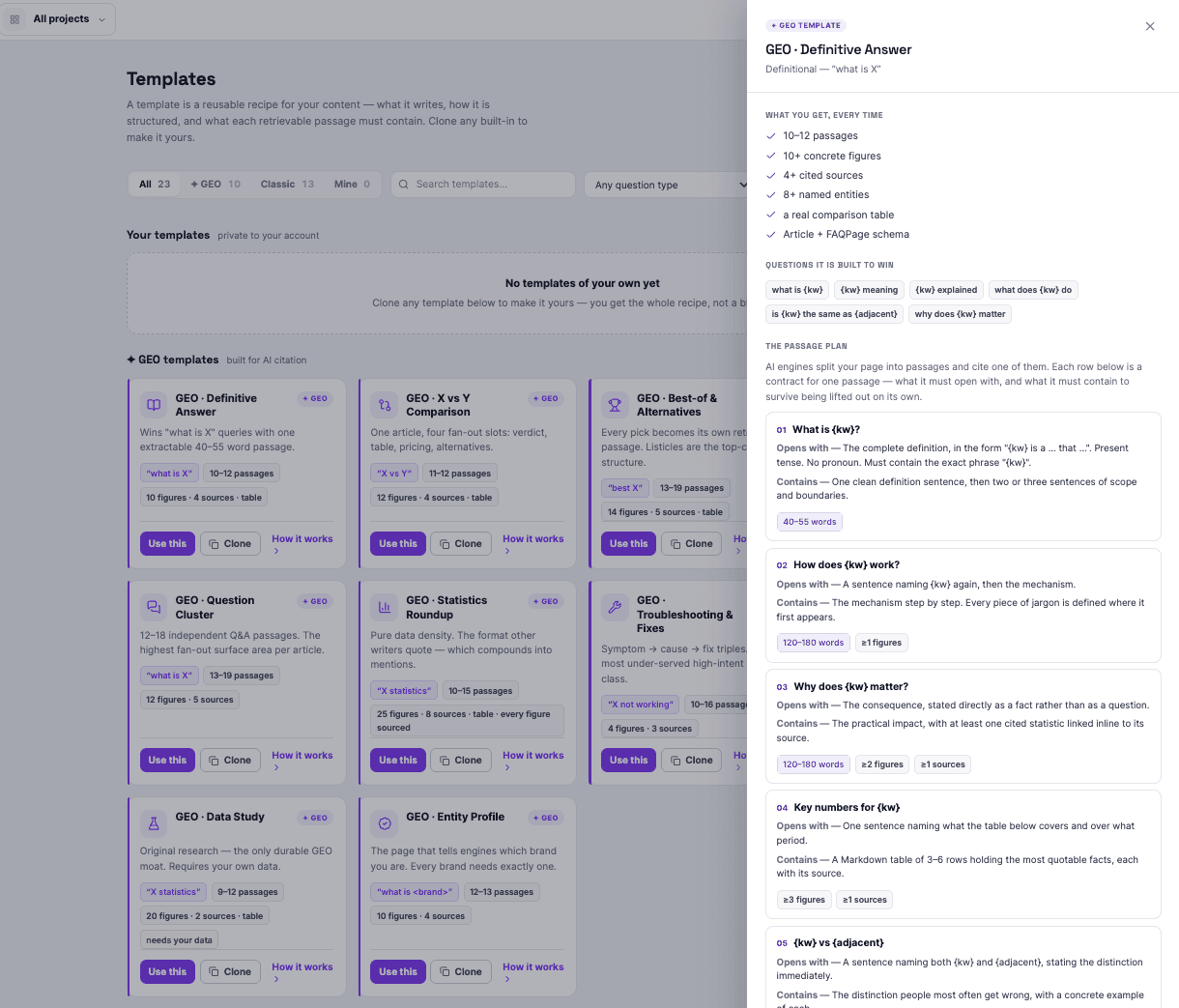
23 formats, and 10 built to be quoted.
This is GEO content generation software built on top of classic SEO structure. 13 Classic formats shape a well-structured article for a human and for Google. The 10 GEO formats add a passage contract: for every retrievable passage, what it must open with, what it must contain, how many concrete figures and sources it needs, and how long it may run.
Open one and you can read the contract itself: passage 01 opens with a definition in the form “{kw} is a … that …”, contains one clean sentence then scope and boundaries, 40–55 words. That is the recipe, and it is visible before you write a word.
Use a built-in as it is, or clone it and change it, cloning is free and lossless, so you start from a working format rather than a blank form. Or describe what you want in a sentence and let AI design one, grounded in your project’s business context.
- Definitive Answer · X vs Y · Best-of
- How-to · Question cluster · Statistics
- Troubleshooting · Pricing · Data study
- Up to 200 custom templates
Ask-AI dock
Aim it at a paragraph and say what you want. It answers with a proposal, and nothing changes in your article until you press Apply, with a 10-second undo after that. If the passage moved while it was thinking, it refuses to apply rather than guessing.
Brand voices
A reusable tone profile (a description plus an optional writing sample) applied across the whole flow: angles, outline, draft and every in-editor edit. Free to create, private to your account, and Copilot shows “Matching <voice>” so you can see it is on.
Documents
Every draft, autosaved continuously: you never press save. Leave mid-sentence and come back to the same text, images and settings, grouped into project folders. Deleting a project never deletes its content.
Numbers you can argue with.
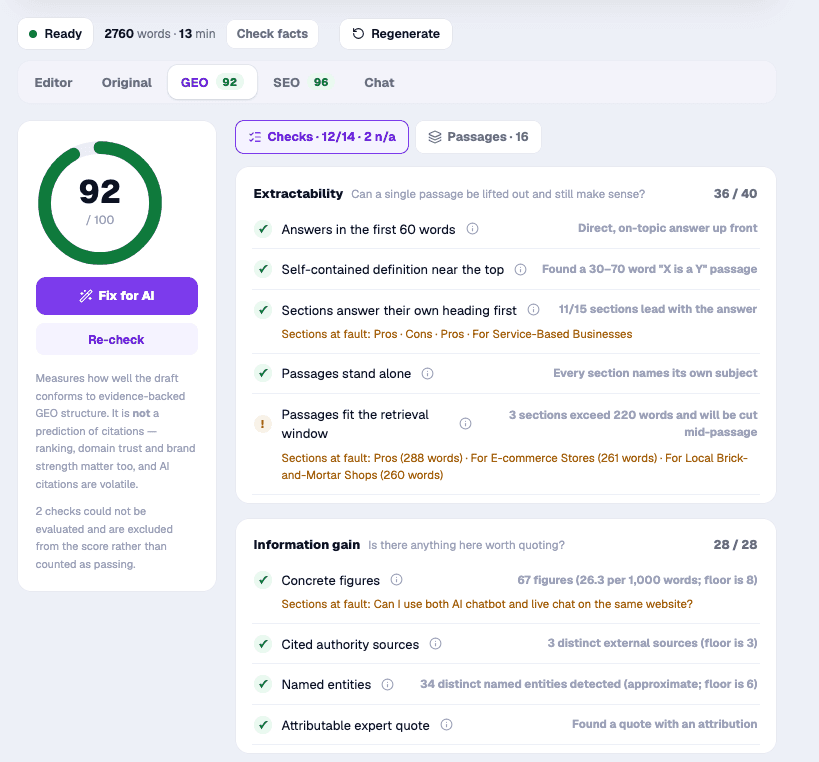
Every score shows its rule, its evidence and the sections at fault, because an AI SEO and GEO tool that only hands you a number is asking you to take its word for it.
Two scores. Deliberately never merged.
SEO runs 13 on-page checks against your keyword: placement, density, headings, title and meta length, alt text, internal and external links, readability. GEO runs 16 deterministic checks in four groups: can a passage be lifted out and still make sense, is there anything here worth quoting, does it match how people ask, can a machine parse it.
GEO names the specific weakest passages and why: buries its answer, opens with a pronoun, carries no concrete figure. And both scores are free and instant; only the AI fixes draw credits.
- Extractability
- Information gain
- Query–answer match
- Machine readability
- Scored against your template’s contract
- Never averaged into one number
It will tell you the article is unverifiable.
The critic scores your draft 0–10 and lists up to five concrete fixes, and because it knows your template, it flags a missing required section rather than “make it punchier”. One click rewrites for exactly those issues, keeping your topic, order and headings.
Check facts then marks every specific claim supported, unsupported or unverifiable, with a reason. It trusts your research findings and your business facts and nothing else, so it will happily tell you it cannot confirm something, which is the honest answer and the one most tools will not give.
- 0–10 with a one-line verdict
- ≤5 concrete, actionable issues
- Revision preserves your headings
- It never invents a source
2 issues worth fixing before publish.
Live research
Searches the web while building your article and feeds current facts and citable URLs in. Roughly one search per article, a 12-second timeout, and it never blocks your draft: a failed search means less sourcing, not a lost article.
Chunk view
Your article as a retrieval engine reads it: one card per passage, each scored on its own and flagged if it opens with a pronoun, buries its answer, or carries no concrete figure.
Real sources only
Citations are mandatory, not optional, and only to URLs from verified research. Any link the model invents is stripped before you ever see it. It will not fabricate a statistic, a price or a quote to satisfy a check.
A page AI can’t fetch
can’t be cited.
However well it is written. This is the half of GEO that has nothing to do with writing.
Can they reach you, and did they?
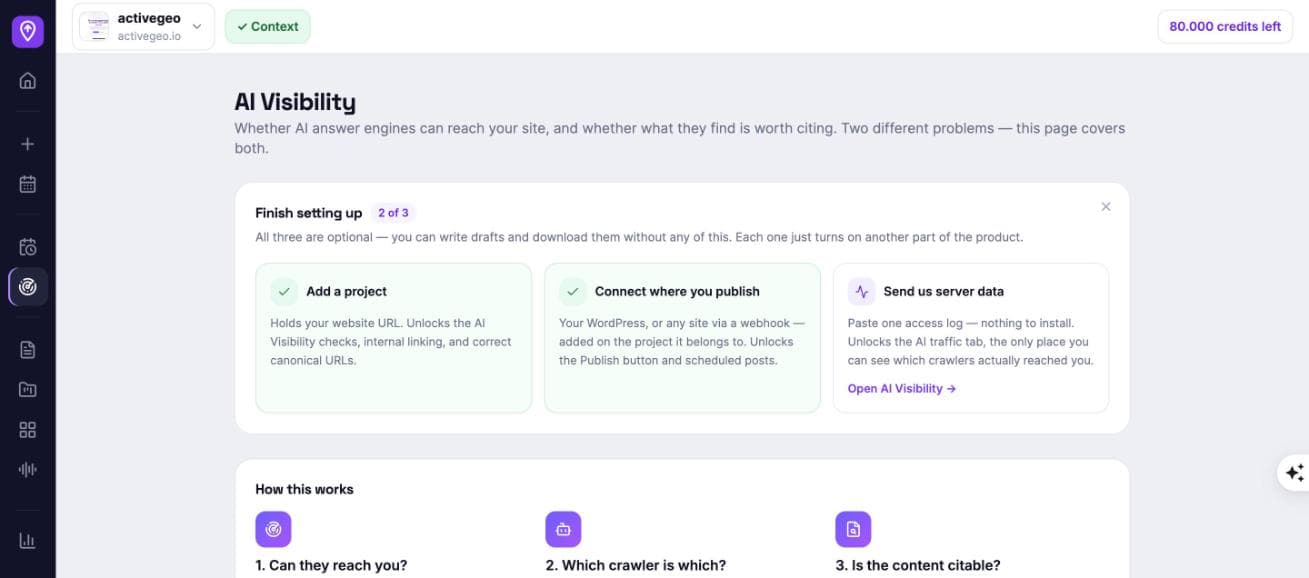
Two different questions, and this answers both. The reachability audit probes your site the way each AI crawler would, reads your robots.txt, and tells you which crawlers are allowed and which are blocked. It needs only your URL, nothing to install. If something is blocked it hands you the exact lines to add, additive, so it never wipes the rules you already have.
Paste one server access log and you unlock the harder truth: which crawlers actually came, and which of your published pages ChatGPT has never fetched. A page it has not seen cannot be cited, no matter how good it is.
- Only your URL, nothing to install
- Exact robots.txt fix, additive
- Coverage gaps: pages never fetched
- 28-day windows
Which crawler is which
Training crawlers, search crawlers and live “someone just asked” fetches are three different things, controlled separately. Blocking GPTBot costs you nothing; blocking OAI-SearchBot removes you from ChatGPT entirely. Most people block the wrong one by accident.
AI traffic from server logs
AI crawlers do not run JavaScript, so no analytics snippet can ever see them. Add one middleware file or paste an access log: that is the only place this data exists.
Entity & internal linking
Automatic internal links to your own published posts using real, resolvable URLs only, plus Organization and author identity with sameAs, which is what tells an engine which brand you actually are.
Where most GEO work gets thrown away.
Publishing is the step that quietly undoes everything above it. This is where it survives.
Set it once. It publishes for ever.
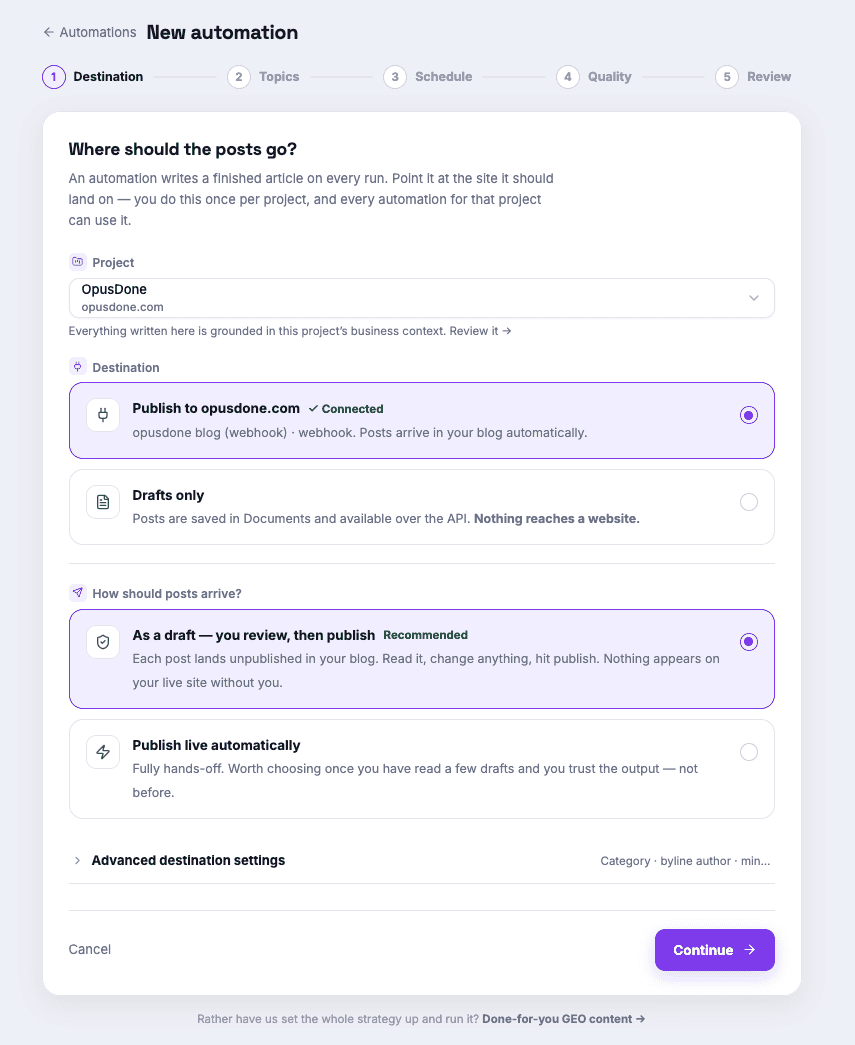
Topics, cadence and destination once, then every run does the full pipeline unattended and files a finished post to your site. Hourly to monthly, in your own timezone, DST-safe, one to five posts per run, topics rotating so nothing repeats.
Set a minimum GEO score and autopilot can never publish below the standard you sell. And a schedule that runs out of credits pauses itself rather than retrying for ever.
- Hourly → monthly, DST-safe
- 1–5 posts per run
- Quality gate before publish
- Auto-pauses on empty credits
Schema on every destination
Article, author Person and Organization JSON-LD with sameAs, cited sources and an accurate dateModified, to WordPress, to your blog, or to any webhook receiver. Not only the destinations that were easy to build.
Canonical across destinations
Publish one article to three places and you get three competing URLs. The first destination owns the canonical and the rest declare it, so the signal concentrates instead of splitting.
Updates, never duplicates
Re-publishing edits the existing post. And if WordPress accepts a post but silently drops your canonical or schema, you are told: a publish with warnings is not a clean success.
Content planner
Every scheduled run and every generated draft on one calendar, per site, so a gap in the plan is visible weeks before it is a gap in your traffic.
Projects
A project is one website: its URL, its business context, its connection. Paste the URL and ActiveGeo drafts the context itself (what you sell, to whom, how you position it), then you edit it. One site per project, so destinations and canonicals never cross.
Images
Hero and inline images, both off by default, so nothing random lands on your live blog. Free licensed stock, your own upload, or one brand hero every post reuses. Attribution added automatically.
Your models, your key,
your bill.
Five models across four providers, one honest meter, and an API that runs the same engine as the workspace.
One meter. No article ceiling.
Everything AI does draws from one credit balance: 100 credits is about one cent of real AI spend, and there is no “articles per month” limit stacked on top, because two meters means one of them is a lie. You see the cost of a generation before and after it runs.
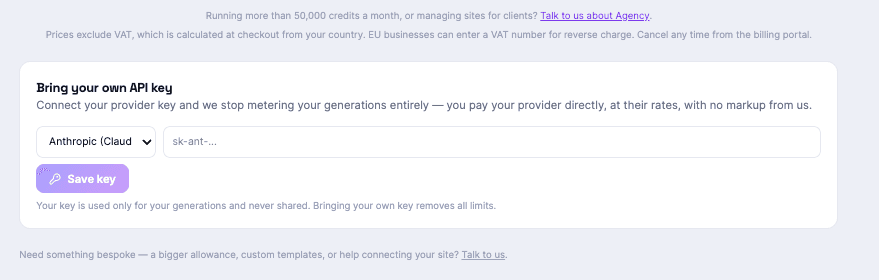
Or plug in your own Anthropic, OpenAI, Google or DeepSeek key: generation becomes unmetered, you pay your provider directly, and we add no markup on a single token. Keys are AES-encrypted and only ever shown masked.
- 5 models, 4 providers
- Switch per article
- Unmetered on your own key
- Keys encrypted, shown masked
Public API
POST /v1/generate runs the same engine and returns the finished article synchronously: id, title, HTML, meta, critic verdict and word count. Plus endpoints for content, schedules, templates and usage.
Scoped keys & webhooks
Bearer keys with scopes and a per-key, per-minute rate limit, shown once at creation and never again. Signed webhooks carry the finished article plus schema, sources, entities and canonical, with retries and a delivery log.
Security
Secrets AES-256-GCM encrypted at rest, API keys hashed, owner-scoped access throughout, prompt-injection sanitisation on every page fetched from the web, and credit checks that fail closed rather than open.
What we deliberately don’t build.
The GEO optimization tool market is full of things that sound right and don’t survive testing. Every competitor sells at least three of these. We leave them out and say why.
- llms.txt generation. Tested across roughly 300,000 domains with no measurable effect on citations. Google compared it to the meta keywords tag.
- Schema sold as a citation lever. A controlled study of 1,885 pages found roughly zero lift. We emit schema for entity identity and agent readability, and we say exactly that.
- A single blended “AI visibility score”. Only about 3.8% of sources are cited by all four major engines. One number hides more than it shows.
- Guaranteed citation claims. Only around 10.6% of cited URLs are still cited 28 days later. Anyone promising a stable position is selling noise.
All of it, free to try.
No card, no countdown. Write on your own site and judge it on the result, then see what it costs.